This interactive session explored how generative AI can support teachers in assessing and activating pupils’ prior knowledge. Attendees engaged with practical tools and discussed strategies for integrating GenAI into lesson planning to enhance learning outcomes. The event highlighted the potential of AI to personalise learning experiences and inform instructional design.
TeachmateAI claims the market share for teacher tools, but what does it offer for ITT?
The GenAI teacher tool landscape is pretty well established now, with many companies offering very shiny tools claiming to reduce teacher workload. So what do you get for free, how can we work with these free tools and what do they have to offer teachers and trainee teachers? This series reviews several existing tools, exploring what they produce for an imaginary teacher, wanting to teach friction to year 4. Here we focus on TeachmateAI and conclude: Free, basic, shallow, introductory.
TeachmateAI is a tool that offer a free (restricted) account and several paid options. you can find it here: https://teachmateai.com/
Here, we create an imaginary teacher, wanting help with their practice, and who has the following user inputs: subject: science, year: 4, topic: friction, objective: to understand factors affecting friction.
The free account gives you access to a few tools, as shown in the screenshot. Some of these are aimed at school leadership (for example, the SIP writer). Here we focus on the free teacher tools only. Some of these tools would be more useful for other subjects, for example the reading book recommendations and mini saga. These don’t lend themselves well to the friction lesson our teacher wants help with, so we won’t be focusing on them here.
Let’s explore these tools:
Activity ideas generator
Concept explainer
Jingle generator
A nice aspect of these tools is the option to refine results. This is common on other tools and seems to be turning into the industry standard. However, we will explore what the limitations currently are with this functionality, in contrast to using a GenAI instead of the TeachmateAI tool.
If you’d prefer to skip ahead to our summary, scroll down.
Activity Ideas Generator
One of the options to ‘refine my answer’ was to ‘differentiate’. Once we had recovered from shock of the use of the ‘dirty word’ of ITT, we couldn’t help but click on it and see what was produced. Compare the two below. Perhaps the educational use of the word ‘differentiation’ (which has varied somewhat over the last 20 years) hasn’t been used by the model, and a more generalised definition of the word has been applied instead?
It gives ten ideas for activities, as you can see in the documents. The ideas are arguably quite ‘large and diverse’ ideas, probably in-keeping with the title ‘creative activities’. There’s not a huge amount of detail, but its a good place to start if you need ideas. Maybe teachers may be left thinking ‘how exactly do I execute this idea?’
The ‘Differentiation’ version (now wash your mouth out!)
The ‘differentiation’ aspect seems to be a bolt-on to the original ideas. Despite being labelled as ‘differentiation’ these bolt-ons are in fact nothing to do with SEND; they are pre-planned modifications to the activity. This is somewhat in contradiction to ITTECF 5.4: ‘Adaptive teaching is less likely to be valuable if it causes the teacher to artificially create distinct tasks for different groups of pupils or to set lower expectations for particular pupils. ‘
Really, these are more alike to prompts for teachers to remember to scaffold. We would have liked to have seen more to hit ITTECF 5.8: High quality teaching for all pupils, including those with SEND, is based on strategies which are often already practised by teachers, and which can be developed through training and support.
Concept Explainer
It produced a three page explainer. Being scientists, we are sad to see it hasn’t actually pulled on any of the wealth of information that is out there, for example the Institute of Physics ‘IOP Spark‘ Platform (which we REALLY hope gets integrated with GenAI very soon, hint-hint nudge-nudge!) or anything from the Association for Science Education and their database. Another criticism is that it’s written with a severe lack of technical vocab, or showing any link with prior and sequential ideas on forces. It’s no match for the great plans that Plan Assess have created without the use of GenAI. On the plus side, it’s a start if a teacher has no experience or existing perception?
When prompted for refining the answer, we just HAD to click on the ‘add in some common misconceptions’ option. The second document below contains the amendments. Again, it’s a start for teacher to remember to consider misconceptions, but it’s missed an opportunity to signpost readers to the sources of information, where they can deepen their subject knowledge.
With added misconceptions. We’d like to have seen links for teachers to deepen their subject knowledge here.
Jingle Maker
We are all for the arts and science combined. But perhaps a somewhat underwhelming jingle on friction….from TeachMateAI here?!
So, we asked Copilot to make a jingle on friction, for comparative purposes. Indulge yourself with its response!
Summary
Lets face it, this is good for free. It’s an introduction. Somewhat missing the opportunity to link to subject specific services and platforms for development of subject knowledge. The functionality is somewhat clunky – it ignores many requests typed into the ‘refine my answer’ box without indicating that it can’t help you. Definitely not hitting the adaptive teaching mark or ITTECF criteria.
Let’s pull out the pros and the cons:
Pro’s:
These tools were free
Gets teachers thinking about misconceptions and scaffolding their materials
Fun little jingles
Cons:
Depth of subject knowledge and misconceptions is missing.
No links to subject-specific information sources or platforms for teachers to improve the depth of their subject knowledge or subject pedagogy
The concept of differentiation is contestable and not aligned to the ITTECF.
No integration of SEND awareness, and not useful for adaptive teaching.
Ignores ‘refine my answer’ requests.
So, in summary let’s say: Free, basic, shallow, introductory.
If anyone has paid for the full version and would like to add to this, please contact us!
Promoting a Distinction between GenAI use in Teacher Education
This blog aims to explore and respond to the GenAI in Education (DfE, 2024) Report and appraise the implications of its subsequent initiative for GenAI in Education. We make a case for GenAI to be included as a key tool for Teacher CPD, including ITT. We use the ITTECF (DfE, 2024) as a comparative framework and make suggestions for further exploring the use of GenAI in the Teacher Education sector. We conclude the major benefit of GenAI to ITT as a sector lies in the ability to bounce ideas off it, rather than get products out of it.
The DfE report ‘GenAI in Education’ (2024) positively summarises the potential of GenAI in Education as these three aspects:
Reduce Teacher’s workload and therefore increase free time to focus on ‘excellent teaching’
Tailor educational materials
Support students with SEND.
Additionally, it acknowledges the ‘risks and challenges’ that will need to be addressed as the sector advances. These risks and challenges are arguably where most exposure and effort currently lie within institutions, as worry about academic integrity and appropriate usage on programmes are rapidly infiltrating the latest cohorts. This report moves away from these risks and challenges to look towards to the potentials of GenAI for Teacher Education, as identified above, and moves to deconstruct these themes into tangible products, tools and approaches that can be used by Teachers and that align with the ITTECF and Teachers’ Standards (DfE, 2012). In essence, to work for and with Teachers and their practice.
Starting with the first perceived positive benefit of GenAI (as above), the obvious implication is to relieve the Teacher of mundane or repetitive tasks and subsequently reduce their workload. This is also identified and explored more fully in the article ‘I, teacher: the five stages to unleashing robot educators’ (Staneff, 2024) recently published by Schools Week (see Image 1). This article quantifies five perceived steps to fully-automated teaching, as summarised in the table, where we identify where the important addition of training-orientated GenAI would be located: across stages 1 to 4.
Through these stages, the role of the teacher moves from ultimate controller to that of an affective consultant. This report argues that the current position of GenAI in Education is between stages 1 and 2 on the typology above, and that existing attempts to ‘automate’ are flawed and currently not fit for purpose. Existing technologies such as Moodle and other platforms can already store grades and adapt course content to individuals: this is not GenAI, this is closer to traditional Software Development and Machine Learning. This difference needs to be reinforced in the sector.
Summary of ‘The five stages to unleashing robot educators’ from Staneff, 2024, with added aim of the GenAI phase and where scenario-based Training-oreintated GenAI would be located.
It could be postulated that the development of Aila, the Oak Academy’s GenAI Assistant, has the aim of moving towards this stage of ‘partial automation’. It has recently been released for general use as a consequence of the ‘GenAI in Education’ report (DfE, 2024). The tool guides the user through the lesson planning process and produces tangible lesson materials such as quizzes, slides and exit tickets, in addition to the lesson plan. Under the hood, it boasts of having a ‘9000 word prompt’ to improve accuracy of material and specifics of its operation are hard to find. When user-tested and asked (for the purpose of this report) to create a lesson for year 6 on Friction it produced slides with little detail and no pictures. The lesson plan it produced does not meet the Teachers’ Standards and would not demonstrate achieving many of the ITTECF (DfE, 2024) criteria. The areas in which it is deficient are also the areas that scenario-based learning for Teachers could address, as will now be explored.
When the stages to automation are integrated with the three core potential benefits of GenAI as described in the DfE GenAI report (2024), it could be suggested that GenAI in Education can split into two categories:
● Task-orientated GenAI: Tangible outcomes are produced or processes undertaken, for example lesson plans, lesson materials, report generation, marking of essays etc. Reducing Teacher workload and tailoring educational materials.
● Training-orientated GenAI: Scenarios are defined (e.g. a child with dyslexia who prefers quiet) alongside an action (create a speech on the Egyptians) for GenAI to appraise (how could this activity be adapted for this scenario). Teacher (or Trainee) reflects and learns by considering the suggested intervention or adaptation. Supporting students with SEND.
To highlight this distinction, consider the potential to ‘support students with SEND’. Aila does not ask or provide an iterative interface to consider how tasks can be adapted for individual needs. This does not fulfil the ITTECF’s (DfE, 2024) ‘Adaptive Teaching’ requirement as it is prescriptive and not responsive. However, training-orientated GenAI could fulfil this criteria because it is used by the Teacher for their professional development.
A teacher can ‘set’ a scenario: i.e. a pupil who identifies with ASD and is noise-sensitive (a barrier to learning, as in ITTECF 5.7 (DfE, 2024)). The teacher can ask GenAI how they could adjust their intended activity for the needs of the student. The prompt could look something like this:
“I am teaching year 9 gravity with the objective of contrasting weight and mass. One of my pupils identifies with ASD and is very noise sensitive. Considering the noise sensitivity, would getting pupils to weigh different objects be a suitable activity?”
The response (try putting it in your own GenAI!) results in multiple pedagogical considerations and learning points, many of which could be integrated into the targets of teacher practice.
This iterative approach could be used to ‘train’ the Teacher through trial and error, without having to expose real pupils to avoidable mistakes in practice. This therefore improves Teacher confidence and promotes a stronger teacher identity. See Hedlund (2024) for further description of how the professional development of a teacher involves iterative child-led continual adaptation and development of practice, related to a wider theoretical context. Essentially, that this process could be repeated for many of the ITTECF criteria.
Suggestions for the Exploration and Advancement of GenAI in ITE and Teacher Education
Task-orientated GenAI
Explore and survey current practice on and between providers
School Exposure: How often do Trainees use GenAI in lesson planning? In class? Do they model use of it with pupils?
Provider diversity: How are providers working with GenAI in their sessions, assessments and on placements?
Aila: Attitude towards and use of Aila.
Training-Orientated GenAI
Session material: Use of scenarios in seminars, lectures and workshops
Case Studies/Assignments: Theoretical case studies (‘what should you do next…’)
School Experience: Trial the use of prior knowledge/misconception tools to demonstrate ITTECF criteria-informed lesson planning
Combining GenAI and Rosenshine’s principles to Personalise your Teaching
Most people in Education have at some point come across Rosenshine’s principles of instruction. Often used as a framework for teaching, you may have even experienced them as interview questions for a job or PGCE entry. But how can GenAI be meshed with Rosenshine’s principles, to enable you to personalise your teaching and feel more confident in your practice? How can it make you more informed and adaptive?
Whether you are an established teacher or new to the profession, first read this overview of how GenAI can be used to action Rosenshine’s Principles of Effective Instruction, resulting in personalisation of teaching, learning and your CPD. Then delve deeper into our series of Blog posts discussing each Principle of Effective Instruction and use our (free!) tools to start feeling the benefit and power of GenAI for your practice.
The recent DfE report ‘Generative AI in Education‘ acknowledged that the impact of GenAI on education could be ‘transformative’. It divides the positive impacts to the sector as being through (1) Helping teachers save time by automating tasks or (2) Improving teaching effectiveness by personalising learning for students (p4). A simple websearch or GenAI request will provide you with many examples of (1). We are different. Our approach in this Blog is to focus on (2) – the use of GenAI to personalise learning. We deconstruct this personalisation to focus on (a) using GenAI to personalise learning for students AND (b) personalise professional development for teachers. We are not yet another website to create lesson plans.
Our tools are based on a social capital and equity model of education. We aim to use GenAI to create indicative child diversity of knowledge, skills, experiences and wider aspects of being that could hold for children in your classroom: Our first GenAI tool gives you well-reasoned examples of what children in your classroom could arrive with. From this, in further Blogs and Tools, we focus on using GenAI to give specific examples of how you can personalise learning for these children, along Rosenshine’s 17 Principles of Effective Instruction.
Rosenshine’s 17 Principles of Effective Instruction
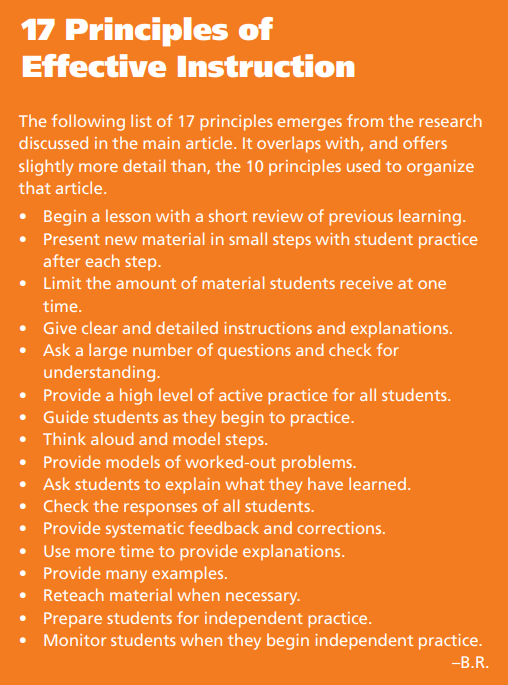
Rosenshine’s 2012 paper defines a framework for teaching and learning practice. He outlines his ten ‘Principles of Instruction’ and then operationalises these principles by turning them into practical suggestions for teaching practice. He defines these as the ’17 Principles for Effective Instruction’, visible in the image above. Potentially, these are the key take-aways you will have been embedding (or are hoping to embed) in your lessons and practice. Or they may be completely new to you. You may want to read his paper to explore his principles in more detail, or you may want to skip straight to our series of blog posts, where we discuss how each of these 17 Principles can be utilised, accessed and quantised using GenAI. You’ll definitely want to use our (free!) tools for teachers to increase your confidence with subject knowledge, pedagogy and adaptive teaching. All through the power of GenAI.
Personalisation as Professional Development
We assume a stance that professional development for teachers is a dynamic, fluid and iterative process: a continual, informed state of progress. This is echoed in the Teachers’s Standards and the Core Content Framework. Our view of professional development isn’t endless attendance on outsourced courses (although we all love a jolly and a day off timetable) and internal speakers on INSET days (when we’d all rather be planning and sorting out our classrooms!). Instead it is something that is present in the learning about (and of) the individual needs of our pupils (our internal data) and matching this with research (action or otherwise) and theory (external data). Therefore for us, the professional development of a teacher involves iterative child-led continual adaptation and development of practice, related to a wider theoretical context.
Join us in our specific Blogs to experience exactly how you can do this…